Pain Narratives and the Media
As I flip through the television channels in
search of something to watch while I do homework, I am struck by a disturbing
pattern in the content that is featured - a fixation with pain. It seems that
in the process of attempting to tell the stories of oppressed peoples, the
media has grown obsessed not with overcoming, but with suffering. In
documentaries about the history of indigenous struggles in North America I
noticed that the vast majority of the discussion taking place was centered
around violence and pain that indigenous folks endured. The same thing is true
for documentaries regarding rape culture, LGBTQ+ experiences, and the everyday
violence that people of color are subject to. This, I will contend, is a bad
starting point for the media.
First, the
emphasis on pain as the basis of discussions of oppression is incredibly dehumanizing.
The media is in the habit of stripping people of their agency and reducing them
to names and numbers who's stories can be sold to the masses - this is an
insidious process which reduces lived experiences to blips of information to be
devoured within the terms of the media. In the process of attempting the share
the experiences of those who's voices need to be heard, the media has silenced
their voices writ large. The author bell hooks said it better than I ever could
when she said:
"No need to hear your voice
when I can talk about you better than you can speak about yourself. No need to
hear your voice. Only tell me about your pain. I want to know your story. And
then I will tell it back to you in a new way. Tell it back to you in such a way
that it has become mine, my own. Re-writing you I write myself anew. I am still
author, authority. I am still colonizer, the speaking subject and you are now
at the center of my talk.”
Second, it
creates a sense of complacency among viewers. The notion that consuming images
of suffering is sufficient to understand lived experience is one that papers
over the need for direct action in order to counter modes of oppression.
Instead of watching a documentary, affirming someone else's pain, and then patting
ourselves on the back, we should coalesce into movements that give folks the
forums they deserve in order to tell their story in its completion. Then, we
should take action to fight the systems which make the pain we are so fixated
on possible in the first place.
All of this
is not to say that we should not tell the ugly parts of people's lives -
rather, the media should work to form a more complete vision of experiences.
For example, instead of just focusing on small pox outbreaks in indigenous
communities, we should be discussing the larger institutions of colonialism and
Eurocentrism which brought the colonizer to those communities in the first
place. Instead of spending an hour long special on the crack epidemic of the
eighties and how much pain it created, we should examine the role that
political systems played in the alienation of communities of color which
enabled that spiral to take place.
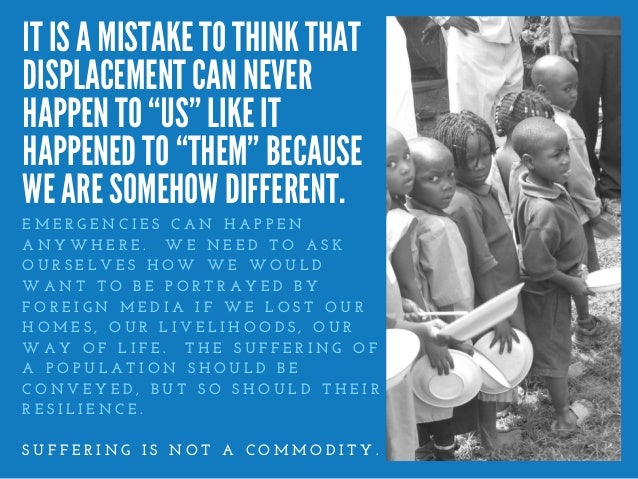
http://www.lse.ac.uk/media@lse/study/pdf/ChouliarakiLSEPublicLectureDistantSuffering.pdf

Comments
Post a Comment